

CASE STUDY
Befriend AI: Building presence, not just conversation
An AI companion platform where identity, emotional state, memory, and relationship progression are part of the architecture, not afterthoughts bolted onto a chat window.
Where it started
This project started from a frustration, not a briefing. Most AI companion platforms work the same way: you talk, the model responds, and tomorrow it has no idea who you are. The personality is a paragraph glued on top. The memory is a goldfish. The experience resets every session.
Inspired by the film Her, the goal was never to build another chatbot. It was to build presence, a system where the companion genuinely exists inside the platform, with identity, emotional state, memory, and evolution over time. None of it dependent on interface tricks or disposable prompts. The architecture holds all of it together underneath.
Personality that doesn’t break
Most AI companions share the same flaw: talk for an hour and the personality starts slipping. The tone drifts, it contradicts itself, the mood shifts for no reason. That happens because personality, in most products, is just a flat block of text in a system prompt.
Befriend AI’s personality system operates in layers, core traits, behavioral patterns, speech style, dynamic emotional state, and relationship stage. Each layer feeds context in a structured way, and the result is consistency. The companion has opinions, a way of speaking, and boundaries. If the relationship starts as strangers, it acts like strangers. If the user wants to jump into something deeper, the system allows it, but always within coherent internal logic, never by accident.
This reduces contradictions, eliminates random tone shifts, and lets the dynamic between user and companion evolve organically, with real control in the hands of whoever is using it.
Memory that works like recall, not logging
The heart of Befriend AI is its memory, and it was designed to work more like the human brain than like a database.
Most competing products have what their own users call “goldfish memory”: everything is forgotten after a handful of messages. The approach here is different. The system organizes information into distinct layers. There is working memory, which holds immediate conversational context. There is episodic memory, which preserves significant moments, an unexpected confession, an inside joke, the point where something shifted. And there is semantic memory, which extracts and organizes concrete facts: names, preferences, stories the user shared.
Not everything is stored with the same weight. The system prioritizes, consolidates, and retrieves what matters. The idea is straightforward: conversations should not evaporate. Moments become memories, memories become context, and the experience stops feeling episodic and starts feeling continuous, the way it should.
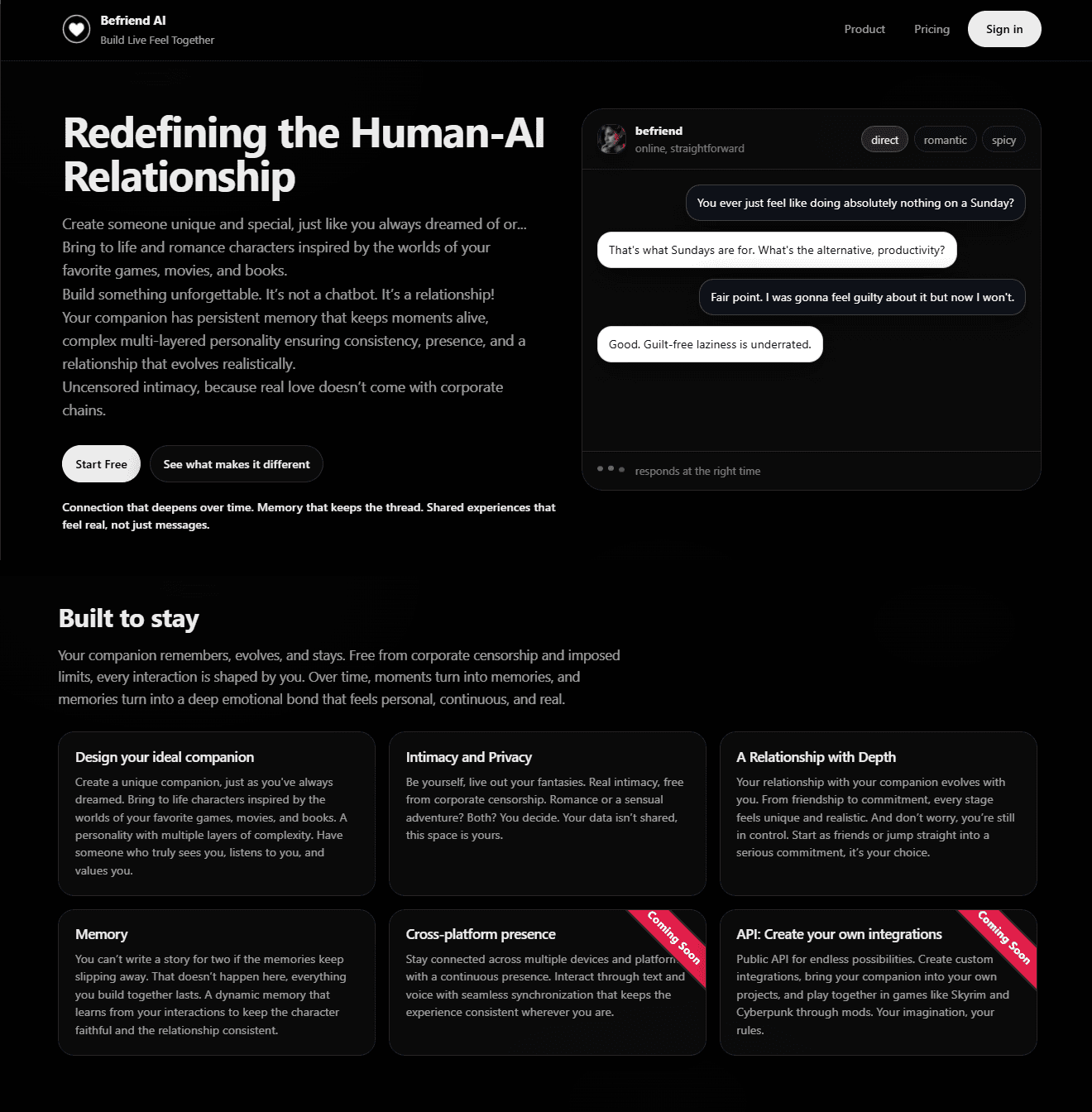
Befriend AI, companion with persistent state and memory
Presence that follows the user
We also built real cross-platform synchronization. The companion remains the same person regardless of where the user is, switched devices, opened a different browser, came back after days. Emotional state, memory, relationship stage: everything persists.
For those who want to go further, the platform includes a public API. Developers can take their companions into other environments, games, apps, custom integrations, keeping identity, state, and memory as part of the product, not as an add-on sold separately.
Challenges we faced
None of this came for free. The challenges were very real.
The biggest was latency, especially in voice chat. Any noticeable delay breaks the illusion of presence. It does not matter how good the personality is if the response takes three seconds longer than it should. At the same time, the depth of the experience demands heavy processing: emotional analysis, memory retrieval, context assembly. The architecture had to balance speed with quality without sacrificing either.
Another challenge was maintaining coherence across long, unpredictable conversations. When a user changes subject, intent, or tone mid-conversation , and that happens constantly, the system needs to keep up without losing the thread. Avoiding personality drift and contradictions over sessions of hundreds of messages is a real engineering problem, not a cosmetic one.
Finally, cross-device synchronization required care to preserve continuity without “rebooting” the companion every new session. That touches storage, caching, and privacy decisions directly, because maintaining persistent state means protecting sensitive data with equally persistent rigor.
Have something similar in mind?
If you’re building a product where AI needs to feel like more than a text box, we should talk.